1. Introduction: The High Stakes of Commercial Outdoor Spaces
The global outdoor living structures market was valued at USD 6.8 billion in 2025 and is projected to reach USD 12.9 billion by 2033, expanding at a CAGR of 7.80%. Within this market, pergolas represent the leading product segment, driven by steady demand for modular, architecturally refined structures that deliver functional shading in both residential and commercial settings. For restaurant operators, hotel general managers, and commercial property developers, the decision between aluminum and wood is not a question of aesthetics alone—it is a financial calculation with consequences that compound over years.
Wood pergolas carry undeniable curb appeal. The natural grain of cedar or redwood, the warmth of timber underfoot, the sense of tradition—these qualities have made wood the default choice for generations. But commercial environments are unforgiving. They demand structures that withstand heavy daily traffic, pass rigorous fire and building code inspections, and minimize operational downtime. A pergola that looks beautiful on opening day but requires four-figure annual maintenance or fails a fire marshal’s inspection is not an asset. It is a liability.
The bioclimatic pergola market reinforces this commercial trajectory. Valued at USD 594.11 million in 2025, it is expected to reach USD 1,167.01 million by 2034 at a CAGR of 7.79%, driven by surging demand for outdoor living spaces that combine comfort with energy efficiency. Within that market, aluminum is the dominant structural material precisely because it delivers what commercial buyers require most: durability, compliance, and near-zero maintenance.
This guide provides a side-by-side comparison of aluminum and wood pergolas across the dimensions that matter most to B2B decision-makers—structural longevity, maintenance economics, all-weather functionality, fire safety compliance, and return on investment.
2. Durability and Structural Longevity: Defying the Elements
2.1 The Vulnerability of Natural Wood
Wood is organic material, and organic material degrades. The U.S. Forest Service Wood Handbook—the authoritative reference on wood as an engineering material—acknowledges that even preservative-treated wood is not completely rot-proof. In humid, coastal, or high-rainfall climates, wood absorbs moisture, swells, and creates ideal conditions for fungal decay. In arid, high-UV environments, lignin—the polymer that gives wood its structural rigidity—breaks down under solar radiation, leading to surface checking, cracking, and progressive loss of strength.
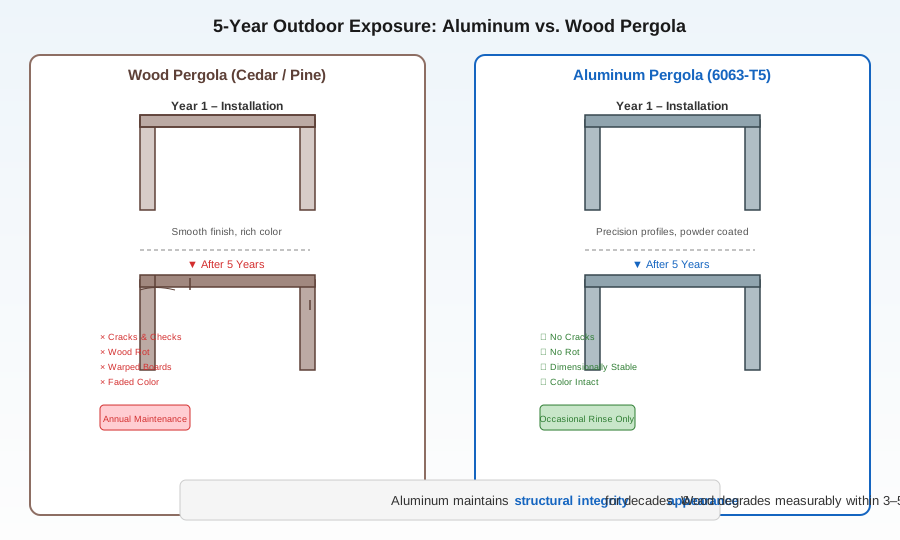
The degradation mechanisms are well documented:
- Rot and decay: Moisture exposure leads to fungal colonization. Common wood pergola issues include rot, insect infestation, and weathering that require sealing, inspections, and timely wood replacement to maintain structural integrity.
- Warping and dimensional instability: Wood is a hygroscopic, anisotropic material. It absorbs and releases moisture with changes in humidity, swelling across the grain while remaining dimensionally stable along it. This differential movement causes boards to cup, twist, and pull away from fasteners over time.
- Termite and pest damage: In regions with active termite populations—much of the southern United States, Southeast Asia, and coastal Australia—untreated or improperly maintained wood structures face ongoing risk of concealed structural damage.
- UV photodegradation: Prolonged exposure to sunlight breaks down wood’s surface lignin, causing graying, surface fiber loss, and progressive thinning of structural members in exposed areas.
Wood pergolas also come with inherent structural variability. As a natural material, every timber contains knots, grain deviations, and micro-checks that create stress concentration points. Under sustained wind or snow load, these natural defects can become failure initiation sites—a risk that engineered aluminum profiles eliminate through metallurgical uniformity.
2.2 The Unyielding Strength of Extruded Aluminum
Aluminum pergolas are fundamentally different. They are engineered products, not harvested materials, and their properties are controlled at the metallurgical level.
6063-T6 aluminum alloy—widely used in structural pergola components—delivers an ultimate tensile strength of 241 MPa and a tensile yield strength of 214 MPa. More importantly for outdoor applications, aluminum naturally forms a protective oxide layer when exposed to air. This layer is chemically stable, self-renewing if scratched, and impervious to moisture. Aluminum does not swell, shrink, warp, or crack from humidity changes.
The structural advantages extend across multiple performance dimensions:
- Wind load resistance: Engineered aluminum pergolas withstand wind speeds up to 85 mph and snow loads of 50 lbs per square foot. For projects in hurricane-prone zones or alpine regions, profiles can be upsized and connections reinforced to meet ASCE 7, EN 1991, or AS/NZS 1170 design standards.
- Dimensional stability: Aluminum’s coefficient of thermal expansion, while higher than steel’s, is predictable and accommodated through engineered connection details. Unlike wood, aluminum does not experience moisture-driven dimensional change. A joint that is tight on installation day remains tight a decade later.
- Corrosion resistance: The natural oxide layer protects aluminum in all but the most aggressive chemical environments. For coastal installations, AAMA 2605-compliant fluoropolymer powder coating provides additional protection against salt spray, rated for 4,000+ hours of salt spray resistance without pitting or coating delamination.
- Lifespan: A properly manufactured aluminum pergola lasts 20 to 30 years or longer. Wood pergolas typically last 10 to 20 years depending on species, climate, and maintenance diligence. This lifespan differential—potentially two to three times longer for aluminum—is the single largest factor in the lifetime cost equation.
Metal and aluminum are increasingly the preferred materials across the outdoor living structures market, driven by their long life, corrosion resistance, and low maintenance costs.
3. The Hidden Cost of Maintenance: The B2B Dealbreaker
3.1 The Endless Cycle of Wood Upkeep
For a commercial operation, maintenance is not an inconvenience—it is an operating expense that directly reduces net operating income. Wood pergolas impose a recurring maintenance burden that many first-time buyers underestimate.
The maintenance cycle for wood pergolas is demanding and non-negotiable. Protective sealing is required every two to three years to prevent moisture damage. Wood stain or paint containing preservative should be reapplied on a yearly basis for softwoods like pine, with extra attention to areas exposed to moisture buildup. Cleaning must be performed at least annually, more frequently in areas with heavy debris accumulation. Hardware must be inspected and tightened as wood naturally compresses around fasteners, and individual boards showing advanced decay must be cut out and replaced.
The financial arithmetic is straightforward:
- Annual maintenance for a wood pergola: 300–800 per year for staining, sealing, and repairs.
- Over a 10-year period, combined material and labor costs for wood pergola maintenance can easily exceed $1,000. In harsh climates or for larger commercial installations, this figure can be substantially higher.
- By comparison, 10-year maintenance costs for aluminum pergolas stay under $100—limited to occasional soap-and-water cleaning.
For a restaurant or hotel operating on thin margins, the difference between 100 and 1,000+ in maintenance costs per decade per structure is material. It directly affects ebitda. For a multi-location chain or a property group with dozens of outdoor installations, the aggregate savings from choosing aluminum can reach tens of thousands of dollars annually—money that flows directly to the bottom line.
3.2 Operational Downtime: The Hidden Multiplier
Maintenance costs are only part of the equation. Wood pergola maintenance requires the structure to be taken out of service—sanding creates dust, staining requires drying time, and sealants need hours to cure. For a restaurant, this means closing the terrace during peak revenue hours. For a hotel, it means guest complaints and reduced amenity value.
The revenue impact of this downtime is significant. A 50-seat restaurant terrace generating 150 perseat perserviceloses 7,500 in revenue for every service period the space is unavailable. If maintenance requires closing the terrace for two full days annually, that represents $30,000 in foregone revenue—on top of the direct maintenance expense.
3.3 The “Set It and Forget It” Advantage of Aluminum
Aluminum pergolas are the definitive low-maintenance solution. As industry reviews consistently note, aluminum pergolas require virtually no maintenance—they never need painting, staining, or sealing. An occasional rinse with water is sufficient to keep them looking new.
This is not merely a convenience. For commercial operators, it means:
- Zero scheduled downtime for maintenance-related closures.
- Predictable operating costs with no annual staining or sealing line items.
- Consistent appearance without the gradual graying, checking, or weathering that affects wood over time.
- No chemical exposure from stains, sealants, or preservatives in areas where food is served.
Aluminum pergolas are also approximately 60% lighter than equivalent wood structures, reducing foundation requirements and simplifying transportation logistics. This weight advantage is particularly significant for rooftop installations, where structural load limits constrain material choices.
4. Bioclimatic Innovation: Monetizing Your Space 365 Days a Year
4.1 Why Static Shade Is No Longer Enough
A traditional fixed-roof pergola—whether wood or aluminum—provides shade but little else. It cannot respond to changing weather. It cannot protect patrons from a sudden rain shower. It cannot adapt to the angle of the sun as the day progresses. In a commercial environment, these limitations translate directly to lost revenue.
The bioclimatic pergola market has emerged to address precisely this gap. Valued at USD 594.11 million in 2025, the market is projected to reach USD 1,167.01 million by 2034, growing at a CAGR of 7.79%. A separate analysis values the 2024 market at USD 555.1 million, projected to reach USD 821.2 million by 2030 at a CAGR of 6.7%-. The broader louvered roof systems market—of which bioclimatic pergolas are a subset—was estimated at USD 1.35 billion in 2025, expected to reach USD 2.48 billion by 2032 at a CAGR of 9.04%.
These numbers reflect a structural shift in how outdoor spaces are valued. Static shade is being replaced by dynamic environmental control.
4.2 Motorized Louvers and All-Weather Control
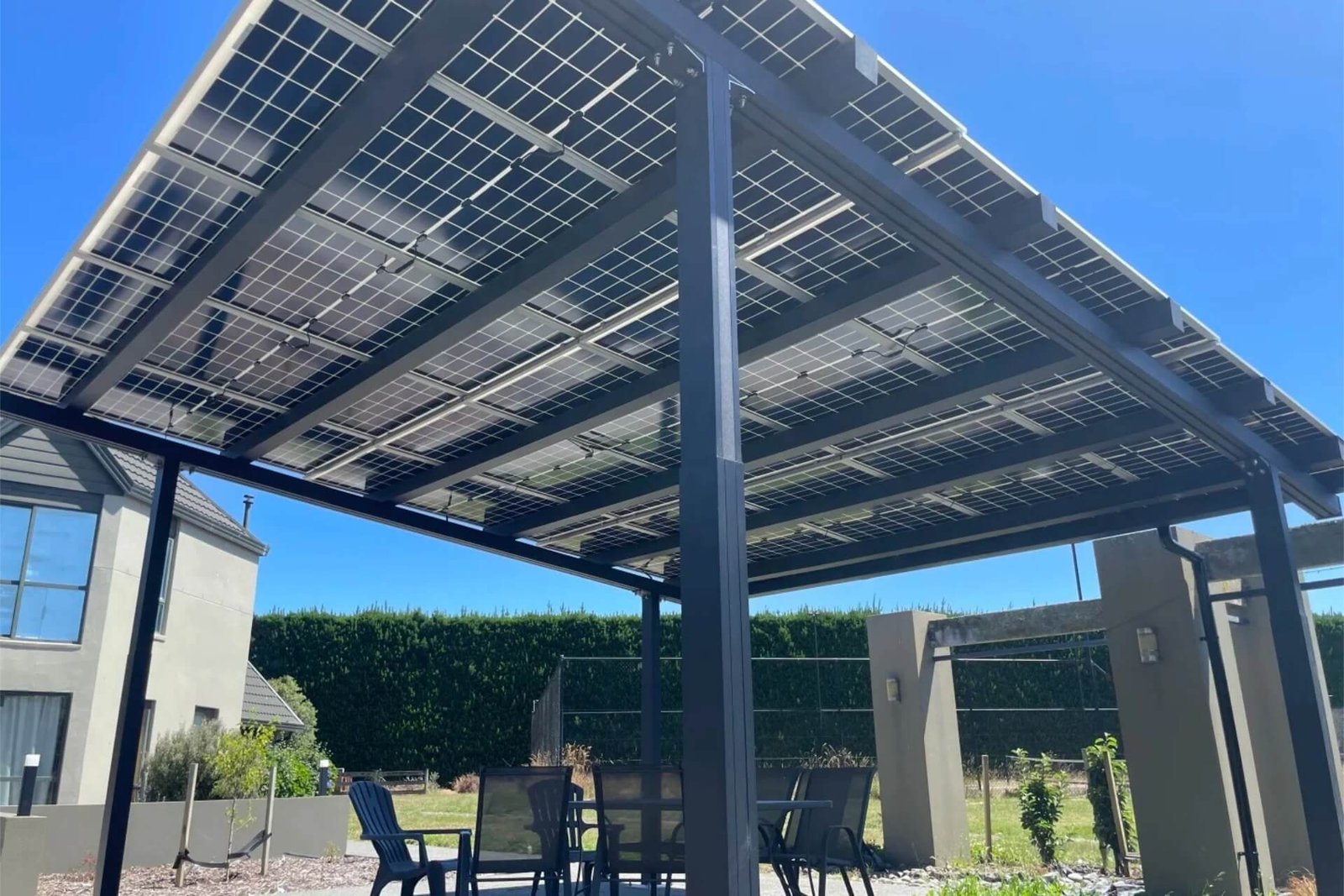
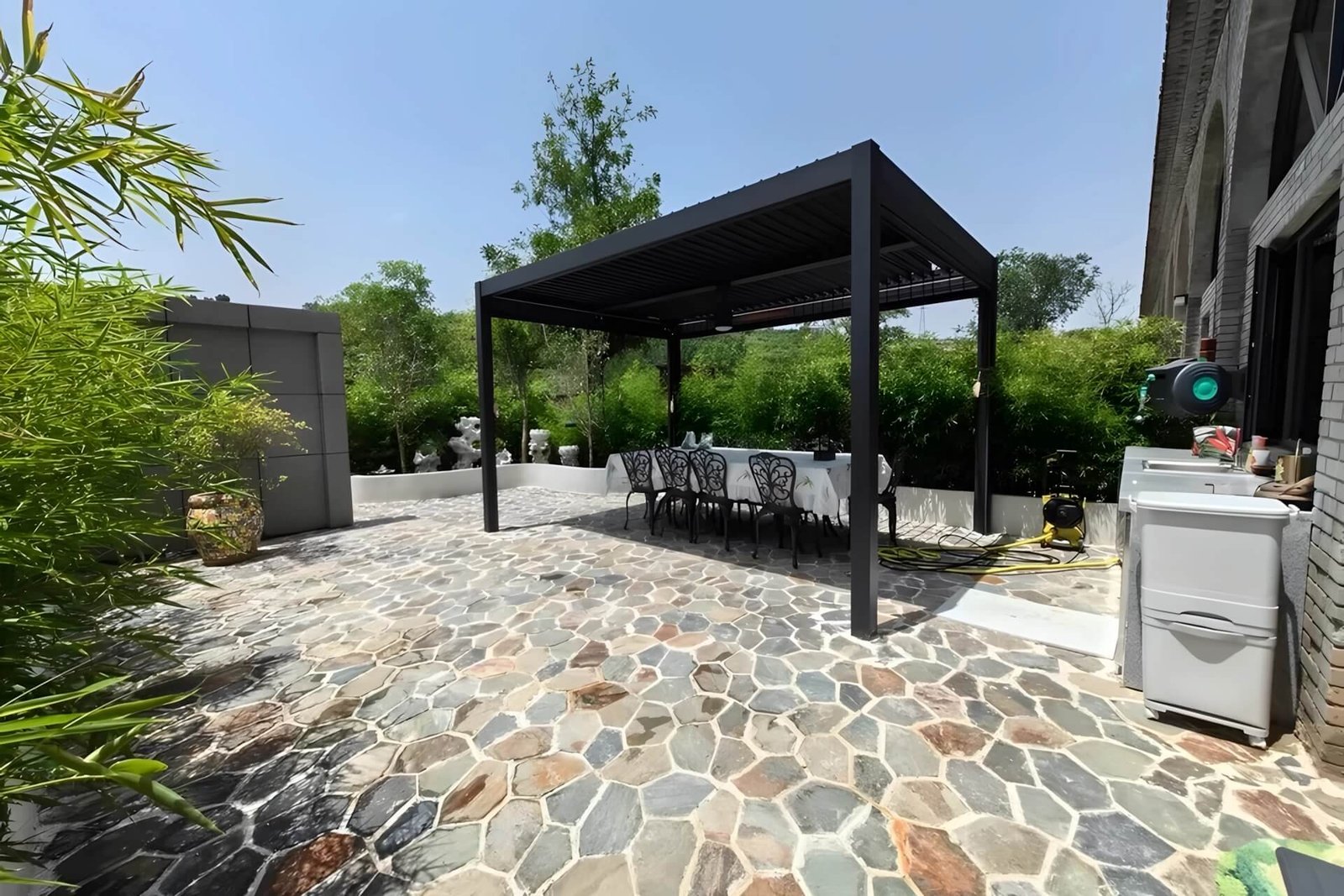
Bioclimatic pergolas feature motorized adjustable louvers that rotate to control sunlight, ventilation, and rain protection. When open, the louvers permit natural light and airflow. When closed, the interlocking profiles form a watertight roof, channeling rainwater through concealed drainage systems integrated within the structural frame.
This capability fundamentally changes the revenue equation for commercial outdoor spaces. A patio that must close during rain now stays open. A terrace that becomes uncomfortably hot at midday now adjusts its louver angle to deflect direct solar radiation while maintaining air circulation. The space transitions from seasonal to year-round.
Smart technology integration enhances this functionality further:
- Rain sensors automatically close louvers when precipitation is detected, protecting furniture and patrons without staff intervention.
- Wind sensors adjust louver angles or retract side screens when wind speeds exceed safe thresholds.
- Sun and temperature sensors optimize louver positioning for thermal comfort and energy efficiency.
- App-based and voice-controlled interfaces—compatible with Amazon Alexa, Google Home, and Apple HomeKit—provide seamless operational control.
The U.S. Department of Commerce reported in 2023 that North American outdoor structures with bioclimatic pergolas increased to 19%, indicating expanding market popularity. The U.S. Department of Energy documented 126,000 automated pergola system houses in its 2023 statistics.
4.3 Why Wood Cannot Deliver Bioclimatic Performance
Bioclimatic functionality demands precision. Louvers must be extruded to exacting tolerances—typically within ±0.3 mm—to ensure smooth rotation, consistent interlocking, and waterproof closure. The structural frame must maintain dimensional stability across temperature and humidity extremes to prevent louver binding.
Wood, as a hygroscopic material that continuously absorbs and releases moisture, cannot maintain the dimensional tolerances required for reliable motorized louver operation over years of service. Boards that swell in humid conditions can bind against adjacent surfaces; boards that shrink in dry conditions can create gaps that compromise waterproofing.
Aluminum, by contrast, is extruded to precise profiles and maintains its dimensions regardless of environmental conditions. This makes it the only viable structural material for motorized bioclimatic systems.
4.4 Commercial-Grade Integrated Features
Modern aluminum bioclimatic pergolas incorporate features that extend functionality beyond shade:
- Integrated LED lighting: Perimeter LED strips and recessed downlights create ambiance for evening dining and events, extending revenue-generating hours into the night.
- Infrared heating panels: Discreetly mounted heaters enable comfortable outdoor dining in cooler months, effectively adding weeks to the spring and autumn revenue calendar.
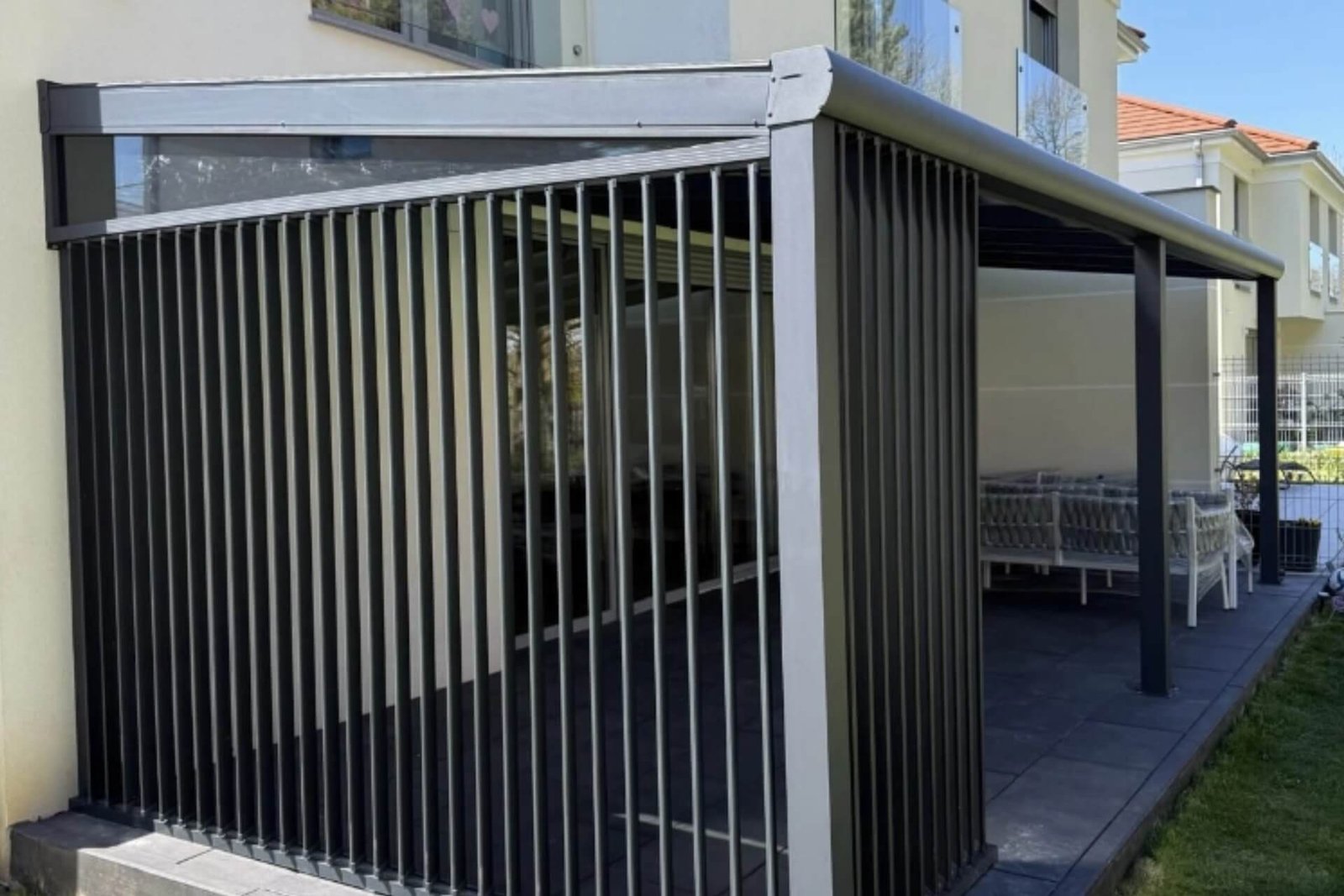
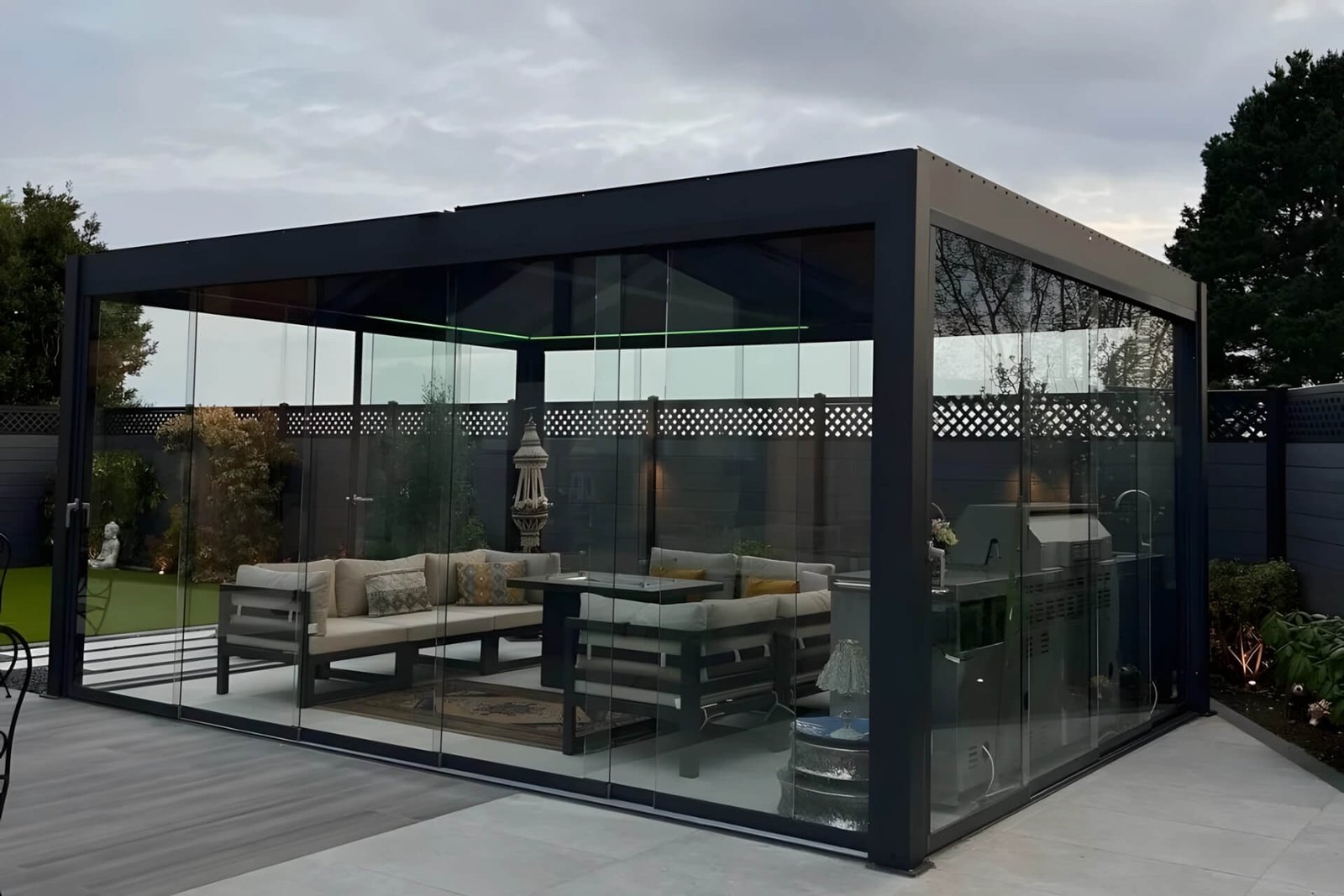
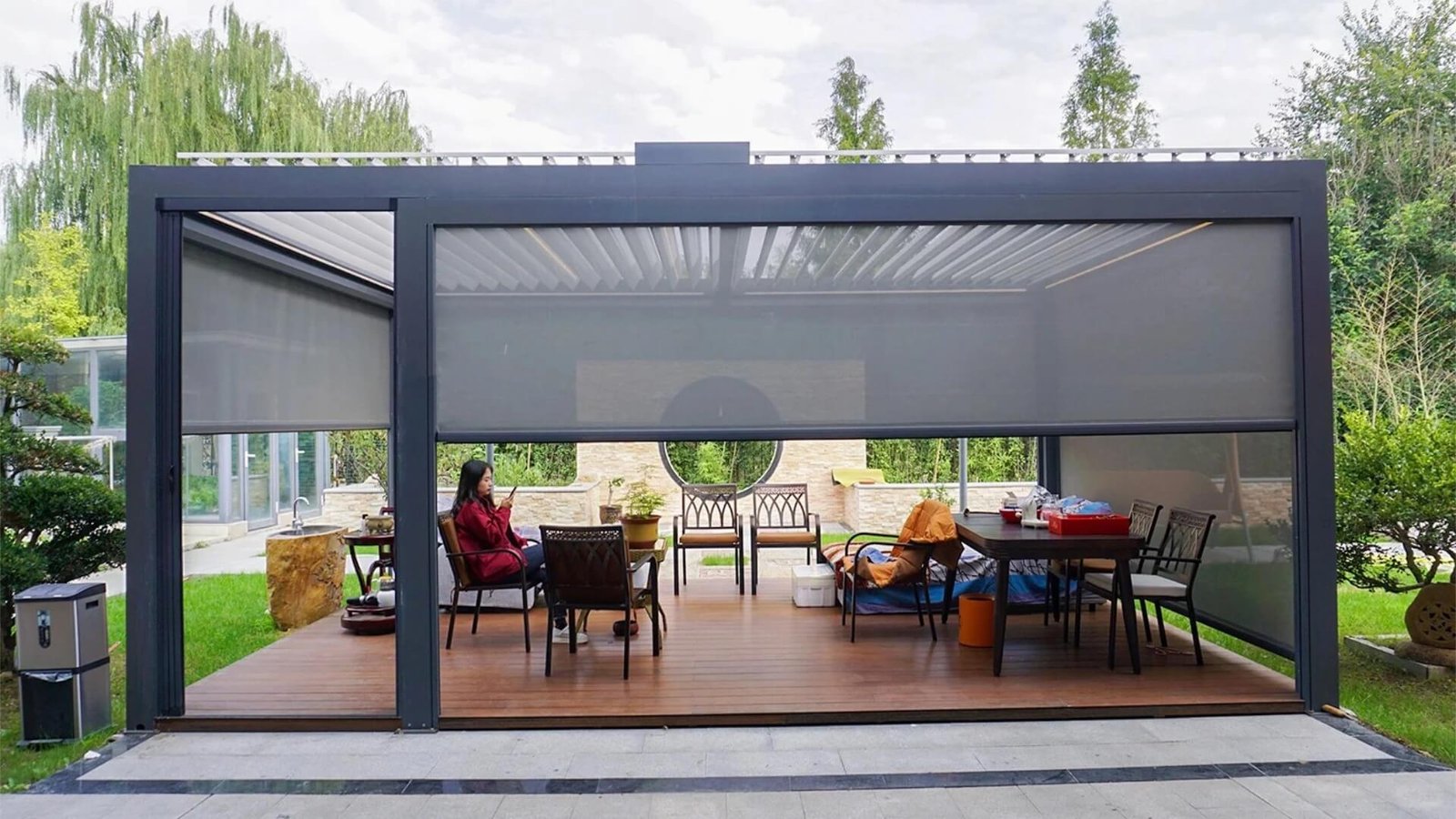
- Motorized side screens: ZIP-track or wire-guided screens provide wind protection and privacy, transforming an open pergola into a semi-enclosed room when conditions demand.
- Concealed drainage systems: Water captured by closed louvers channels through integrated gutters in the main beams, travels invisibly through the hollow core of structural posts, and discharges at ground level—eliminating the need for externally attached downspouts that compromise architectural aesthetics.
These features are engineered into the aluminum extrusion profiles during manufacturing. They are not aftermarket add-ons. This integration is possible because aluminum can be extruded into complex, multi-chamber profiles that combine structural, drainage, electrical, and aesthetic functions within a single cross-section. Wood, limited to what can be cut, planed, and joined, cannot approach this level of functional integration.
5. Safety, Fire Codes, and Building Compliance
5.1 The Regulatory Reality for Commercial Projects
Commercial structures are subject to building codes and fire regulations that simply do not apply to residential DIY projects. The International Building Code (IBC), NFPA 1 (Fire Code), and NFPA 101 (Life Safety Code) collectively govern material selection, flame spread ratings, smoke development indices, and structural fire resistance for commercial occupancies.
For restaurant terraces, hotel pool decks, and rooftop bars—spaces classified as assembly occupancies with high occupant loads—these regulations are enforced rigorously. Fire marshals inspect. Insurance underwriters review. Non-compliance is not a theoretical risk; it carries tangible consequences including fines, forced closure, and insurance policy cancellation.
5.2 Aluminum: The Fire-Safe Choice
Aluminum is non-combustible. It does not ignite, does not contribute fuel to a fire, and does not produce flaming droplets or toxic smoke when exposed to high temperatures. These properties make aluminum pergolas inherently compliant with the non-combustible material requirements of IBC construction Types I and II—the most restrictive classifications typically applied to commercial, high-rise, and assembly buildings.
For rooftop installations, aluminum’s fire performance is particularly significant. Building codes impose stringent restrictions on combustible materials at elevated locations where firefighting access is limited. An aluminum pergola on a rooftop bar passes these requirements without additional fire-retardant treatment, documentation, or ongoing certification.
5.3 Wood: Compliance Requires Compromise
Wood is a combustible material. Under the IBC, untreated wood is restricted or prohibited in many commercial construction types. Section 1406 of the IBC places specific limitations on combustible materials in exterior walls and appendages of Type I and II buildings.
Fire-retardant-treated (FRT) wood can be used in certain applications, but it introduces costs and complications:
- FRT wood is more expensive than untreated lumber and requires certified application at the treatment facility.
- The fire-retardant chemicals can be corrosive to metal fasteners and connectors, requiring stainless steel or specially coated hardware throughout.
- FRT wood’s fire performance can degrade over time with exposure to moisture and UV radiation, potentially requiring re-treatment or re-certification.
- In jurisdictions with the strictest interpretations, FRT wood is still not considered equivalent to non-combustible material, and its use may be rejected by the authority having jurisdiction.
For the commercial buyer, the choice is practical: aluminum passes fire code on day one and every day thereafter, with no treatment, no documentation burden, and no degradation of fire performance over the structure’s service life. Wood requires ongoing management of fire compliance—another recurring cost and administrative obligation that aluminum eliminates entirely.
5.4 Weight Considerations for Rooftop and Elevated Installations
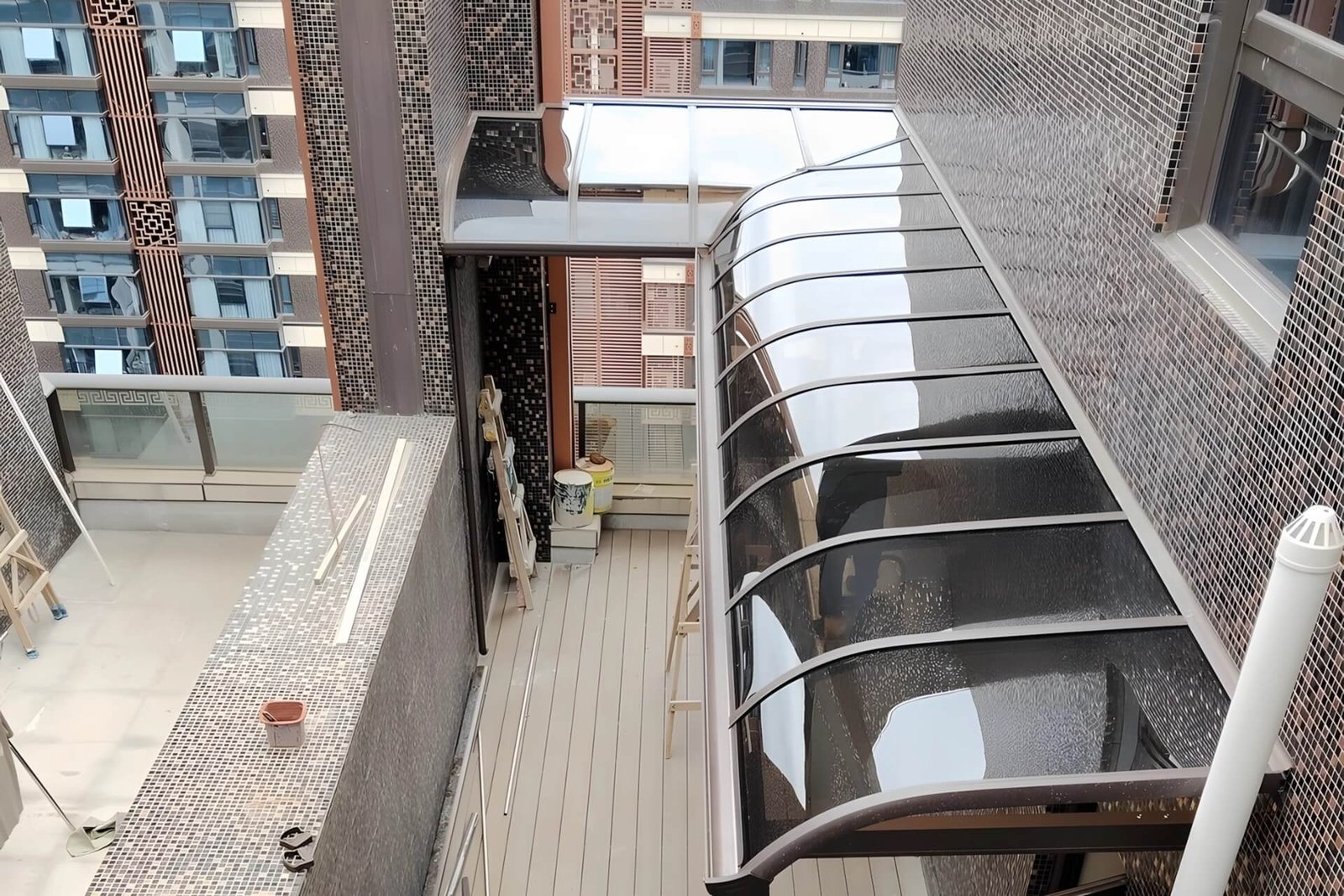
Many of the most desirable commercial outdoor spaces are on rooftops, terraces, or elevated decks where structural load capacity is limited. Aluminum pergolas weigh approximately 60% less than equivalent wood structures—a difference that can determine whether a rooftop installation is structurally feasible without expensive reinforcement of the existing building frame. For hotel rooftop bars and restaurant terraces in dense urban areas, this weight advantage can make the difference between a project that proceeds and one that is structurally or financially unviable.
6. The ROI Equation: Making the Business Case
6.1 Upfront Cost Reality
An honest comparison must acknowledge that aluminum pergolas typically carry a higher initial material cost. Industry pricing data indicates that aluminum and vinyl pergola kits cost 10 to 40 per square foot, while custom aluminum builds range from 30 to 60 per square foot. Wood pergolas, depending on species and construction quality, range from 20 to 55 per square foot. A standard wood structure might cost 2,000 to 6,000, with aluminum of equivalent size at the higher end of that range or slightly above.
However, this upfront comparison is misleading when viewed in isolation. It ignores every cost that accrues after installation—and in a commercial context, post-installation costs dominate the total cost of ownership.
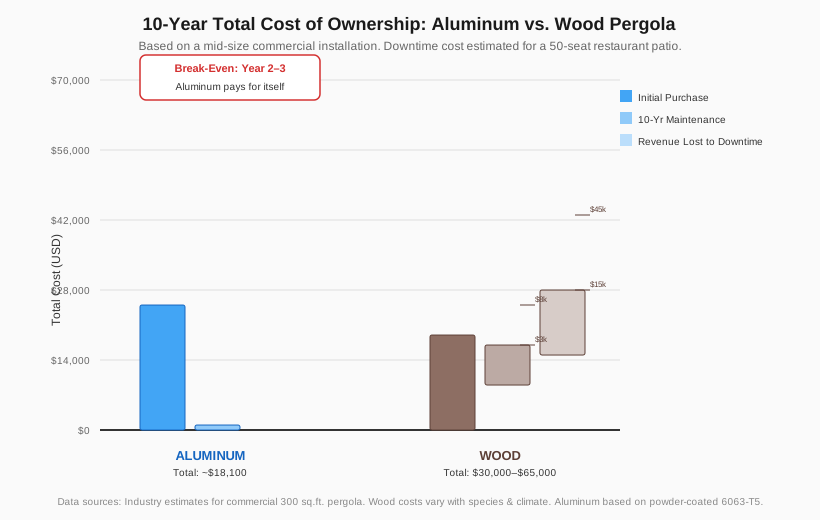
6.2 The 10-Year Total Cost of Ownership
A proper financial comparison must extend across the structure’s service life. Consider two equivalent pergolas—one aluminum, one wood—installed at a commercial restaurant:
| Cost Category | Aluminum Pergola | Wood Pergola |
|---|---|---|
| Initial Installation | $18,000 | $12,000 |
| Annual Maintenance | 0–10 | 300–800 |
| 10-Year Maintenance Total | ≤$100 | 3,000–8,000+ |
| Operational Downtime | 0 days/year | 1–3 days/year |
| Revenue Lost to Downtime (est.) | $0 | 15,000–45,000 |
| Expected Replacement | Year 25–30 | Year 12–18 |
| 10-Year Total Cost | ~$18,100 | 30,000–65,000 |
Sources: GreenAwn Group, Royal Covers, Western Timber Frame, Titan Sunrooms
The aluminum pergola reaches breakeven against the wood alternative within approximately two to three years of operation, after which it generates positive return relative to wood every year for the remaining two decades of its service life.
This analysis uses conservative assumptions. In harsh climates—coastal locations with salt spray, regions with heavy snow loads, or areas with high termite pressure—the wood maintenance costs escalate while aluminum’s remain unchanged. In those conditions, the aluminum breakeven occurs even faster.
6.3 Revenue Enhancement Beyond Cost Savings
The ROI case extends beyond cost avoidance to revenue generation. A bioclimatic aluminum pergola with motorized louvers, integrated heating, and LED lighting transforms outdoor space into year-round, weather-independent seating. For a restaurant:
- Tables that would be empty during rain or extreme heat become revenue-generating.
- Evening service extends later into the night with integrated lighting and heating.
- Spring and autumn dining seasons extend by weeks on either end.
- Private events—wedding receptions, corporate gatherings, holiday parties—can be booked without weather-cancellation risk, commanding premium pricing.
The structure pays for itself not just through maintenance savings but through the revenue it enables. Properties with bioclimatic pergolas fall within the growing category of climate-responsive architecture, increasingly recognized in property valuations and sustainability certifications. Well-designed pergolas of either material can return 50 to 80 percent of their cost at resale—but aluminum’s zero-deterioration appearance at the time of sale gives it a measurable advantage in property transactions.
7. Conclusion: The Verdict and Your Next Step
The aluminum-versus-wood debate is not a matter of personal preference when commercial outcomes are at stake. The data supports a clear conclusion:
Durability: Aluminum lasts 20–30+ years with no degradation. Wood lasts 10–20 years with progressive weathering, even with diligent maintenance.
Maintenance: Aluminum requires an occasional rinse. Wood requires annual cleaning, biennial sealing, and periodic staining—at a cost of 300–800 per year.
Functionality: Aluminum supports motorized bioclimatic louvers, integrated drainage, LED lighting, and smart controls. Wood cannot maintain the dimensional tolerances required for these systems.
Compliance: Aluminum is non-combustible and passes commercial fire code without treatment. Wood requires fire-retardant treatment and ongoing documentation for many commercial occupancies.
Total Cost: Aluminum reaches breakeven against wood within 2–3 years and delivers substantial savings over the remaining two decades of its service life.
Partner with Oude Outdoor
For B2B buyers—distributors, contractors, hospitality groups, and architectural specifiers—the choice of material is only part of the sourcing equation. Equally important is the choice of manufacturing partner.
Oudeoutdoor operates a 15,000-square-meter automated production facility in Foshan City, Guangdong—the heart of China’s aluminum industrial ecosystem. With over 100 production specialists, CNC automatic cutting machines, press brakes, and automated folding lines, we deliver precision-engineered aluminum pergolas, carports, gazebos, and awnings for global export markets.
Our OEM and ODM services are designed for flexibility. Provide your technical drawings, and we manufacture to your exact specifications—custom dimensions, proprietary connection systems, branded packaging, and regional compliance certifications. Alternatively, leverage our catalog of proven bioclimatic pergola designs and customize roofline styles, louver configurations, post dimensions, finish specifications, and smart control integrations to match your market requirements.
Every structure leaving our factory is engineered for its target market’s wind and snow load standards—ASCE 7 for North America, EN 1991 for Europe, AS/NZS 1170 for Oceania. We offer AAMA 2604 and AAMA 2605-compliant powder coating in over 100 RAL colors, ensuring long-term corrosion resistance in coastal and high-UV environments.
Ready to add industry-leading aluminum pergolas to your commercial project portfolio? Contact Oudeoutdoor today to discuss custom CAD designs, factory-direct pricing, structural compliance for your target markets, and project timelines. Your outdoor space deserves an engineered solution—not a maintenance obligation.