Introduction: Why Coastal Properties Demand a Different Kind of Pergola
A pergola that thrives in an inland garden can quietly fail on a beachfront terrace. The difference isn’t visible at first glance — it’s in the salt-laden air, the relentless onshore wind, and the intense, unobstructed UV that define every coastal microclimate. For hotel owners, resort operators, and commercial specifiers, choosing the wrong structure means more than a maintenance headache: it means premature corrosion, wind-damaged louvers, and a shading investment that underperforms from year two onward.
This guide is written for B2B buyers — hotel groups, resort developers, architects, and distributors sourcing for coastal projects. It explains exactly what makes an aluminum bioclimatic pergola genuinely “coastal-grade,” how to specify for salt corrosion and wind uplift, and what to verify before you commit. Along the way, we’ll draw on a real installation we delivered for a boutique hotel in Morocco, where our motorized bioclimatic pergola now stands as the centerpiece of a stone courtyard facing the North African coast.
By the end, you’ll know how to source a structure that won’t just survive the coast — it will be the reason your guests stay longer and book again.
1. Why Standard Pergolas Fail at the Coast (And How to Spot the Risk Early)
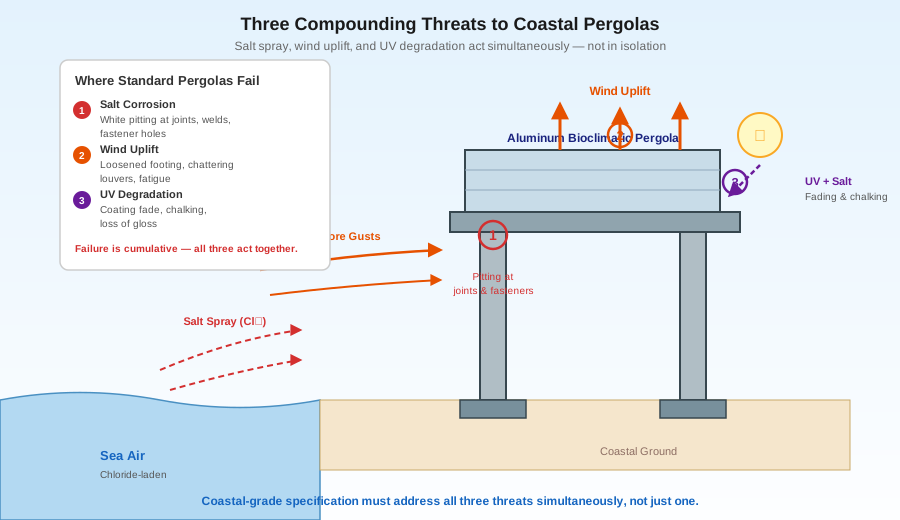
The coastal environment attacks outdoor structures through three compounding forces that inland sites never fully replicate.
Salt spray corrosion. Sea air carries microscopic chloride particles that deposit on every exposed surface. On raw steel, this triggers accelerated rusting within months. On aluminum, the risk is subtler but real: unprotected aluminum can develop white powdery oxidation (pitting) at joints, welds, and fastener holes — precisely where structural integrity matters most. A pergola that looks fine on the showroom floor can be quietly degrading at its connection points.
Wind uplift and gust loading. Coastlines experience higher and more turbulent wind than inland areas. A louvered roof is essentially a large horizontal surface, and strong gusts create uplift forces that want to tear the structure off its anchors. The failure mode is rarely a snapped column — it’s a lifted or loosened footing, or louvers that chatter and fatigue under repeated buffeting.
Intense UV and salt-catalyzed fading. Coastal UV is unfiltered and relentless. Combined with salt, it accelerates powder-coating degradation, causing fading, chalking, and loss of gloss on cheaper finishes. Over a few seasons, a poorly coated pergola goes from “premium” to “tired.”
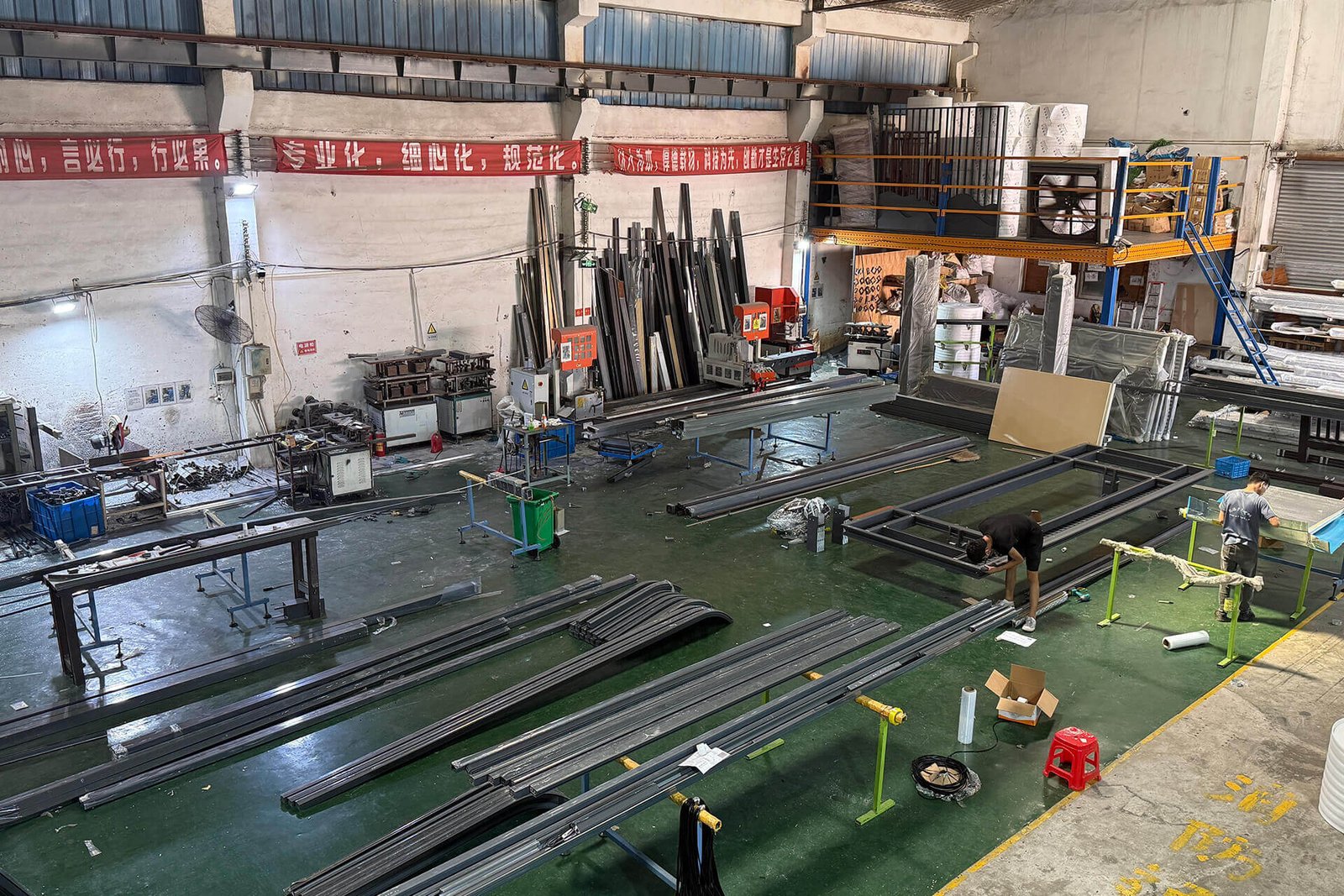
How to spot the risk early: If a supplier can’t tell you the aluminum alloy grade, the powder-coating brand and specification, or the wind-load rating of their design, that’s your first red flag. Coastal grading isn’t a marketing term — it’s an engineering specification. In our own 15,000㎡ manufacturing facility, every coastal project starts with these three numbers, not with a catalog photo.
2. The Material Science: Why 6063-T5 Aluminum + Premium Powder Coating Wins at the Coast
When engineers specify for marine and coastal environments, they reach for aluminum for one reason above all: it doesn’t rust the way steel does. But “aluminum” alone isn’t enough — the alloy and the finish are what separate a 5-year structure from a 15-year one.
2.1 Alloy grade matters
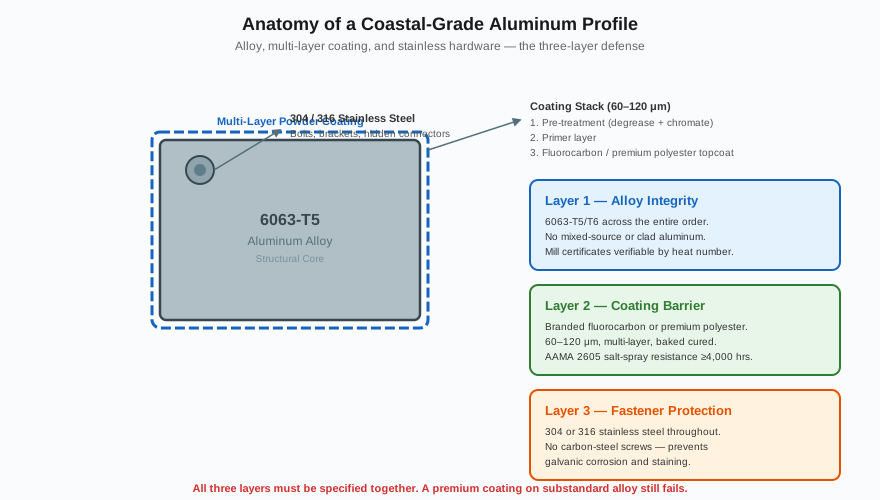
Coastal pergolas should be built from 6063-T5 (or T6) aluminum alloy. This alloy offers the right balance of strength, corrosion resistance, and extrudability for structural profiles. Lower-grade or mixed-source aluminum — or, worse, aluminum-clad steel — introduces galvanic corrosion risks at every dissimilar-metal contact point. A manufacturer that controls its extrusion sourcing can guarantee alloy consistency across an entire order, which is critical when you’re buying 50 or 500 units for a resort.
2.2 The powder coating is your first line of defense
The frame’s corrosion resistance depends overwhelmingly on the coating. Premium coastal projects specify fluorocarbon or high-grade polyester powder coating from a recognized brand (such as Akzo Nobel or equivalent), applied in a multi-layer process. This is what resists salt-induced chalking and fading. A thin, unbranded coating will look identical on day one and fail years earlier.
2.3 Stainless steel fasteners — the hidden spec
The most common coastal failure we see in the field is not the frame but the fasteners. Ordinary carbon-steel screws corrode in salt air and can even stain surrounding aluminum. Coastal-grade pergolas use 304 or 316 stainless steel hardware throughout, including bolts, brackets, and hidden connectors. This is a small detail on a spec sheet and a huge deal after three winters of sea air.
Internal link opportunity: For a deeper dive into how these structures are engineered to resist structural loads, see our technical guide on wind and snow load engineering.
3. Engineering for Wind: What “Windproof” Actually Means on a Beachfront
A coastal pergola’s most important engineering question is simple: how does it handle wind uplift? Here’s what to verify with any supplier before you buy for a beachfront site.
3.1 Understand the load path
A louvered roof transfers wind forces down through the columns and into the ground. The design must specify:
- Roof louver profile and stiffness — thin, flexible louvers flutter in gusts; engineered louvers are rigid enough to stay true.
- Column-to-beam connections — bolted, high-tensile connections that can’t pull out under uplift.
- Footing and anchoring — the ultimate anchor point. Freestanding pergolas need properly engineered footings sized for the site’s wind zone, not just a decorative base plate.
3.2 Ask for a wind-load rating
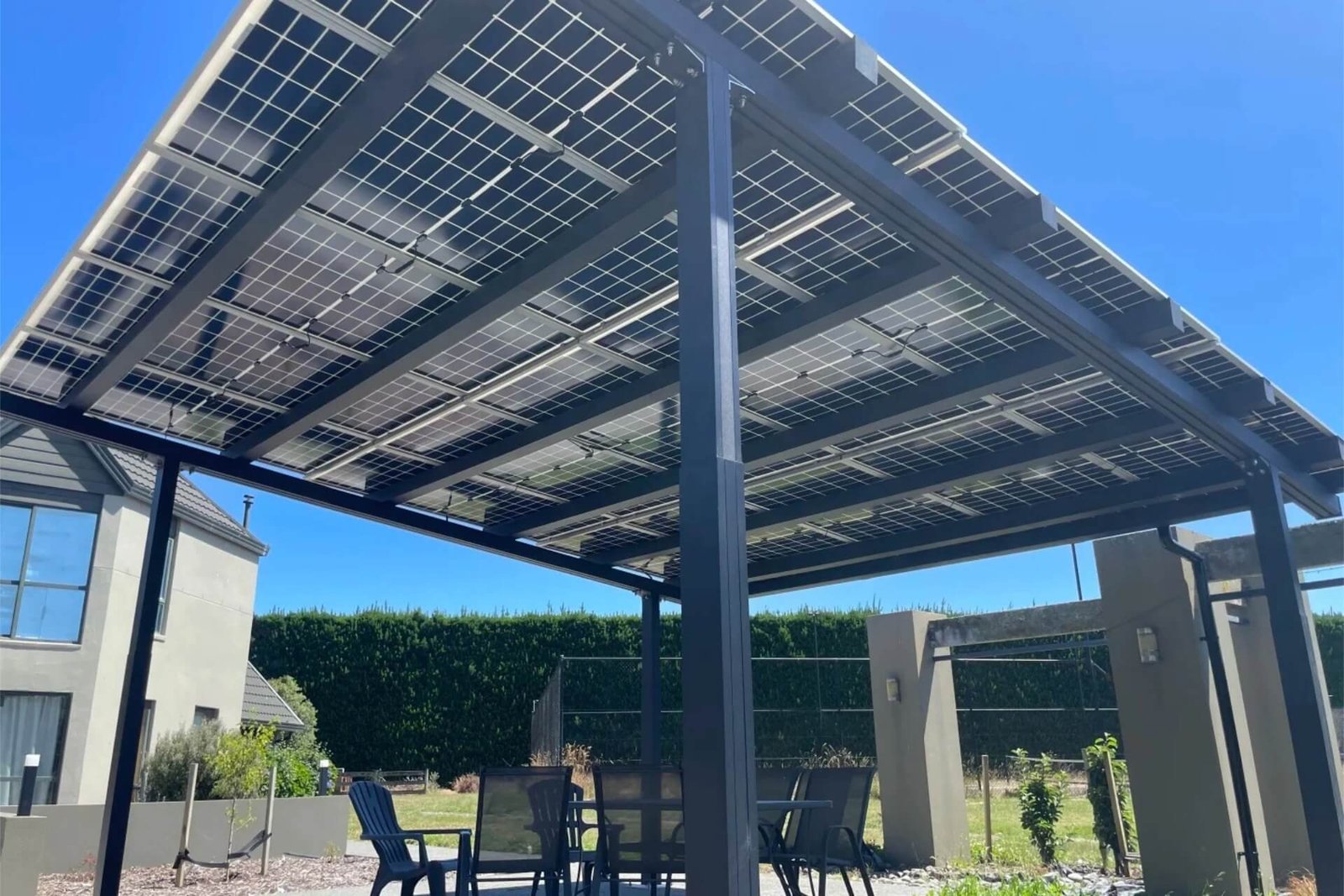
Reputable manufacturers design to recognized standards such as ASCE 7 (US), EN 1991 (Europe), or AS/NZS 1170 (Australia). Ask for the design wind speed or the Beaufort rating the structure is engineered for. A supplier that can produce this number — rather than a vague “wind-resistant” label — is one that has done the structural math.
3.3 Wind screens do double duty
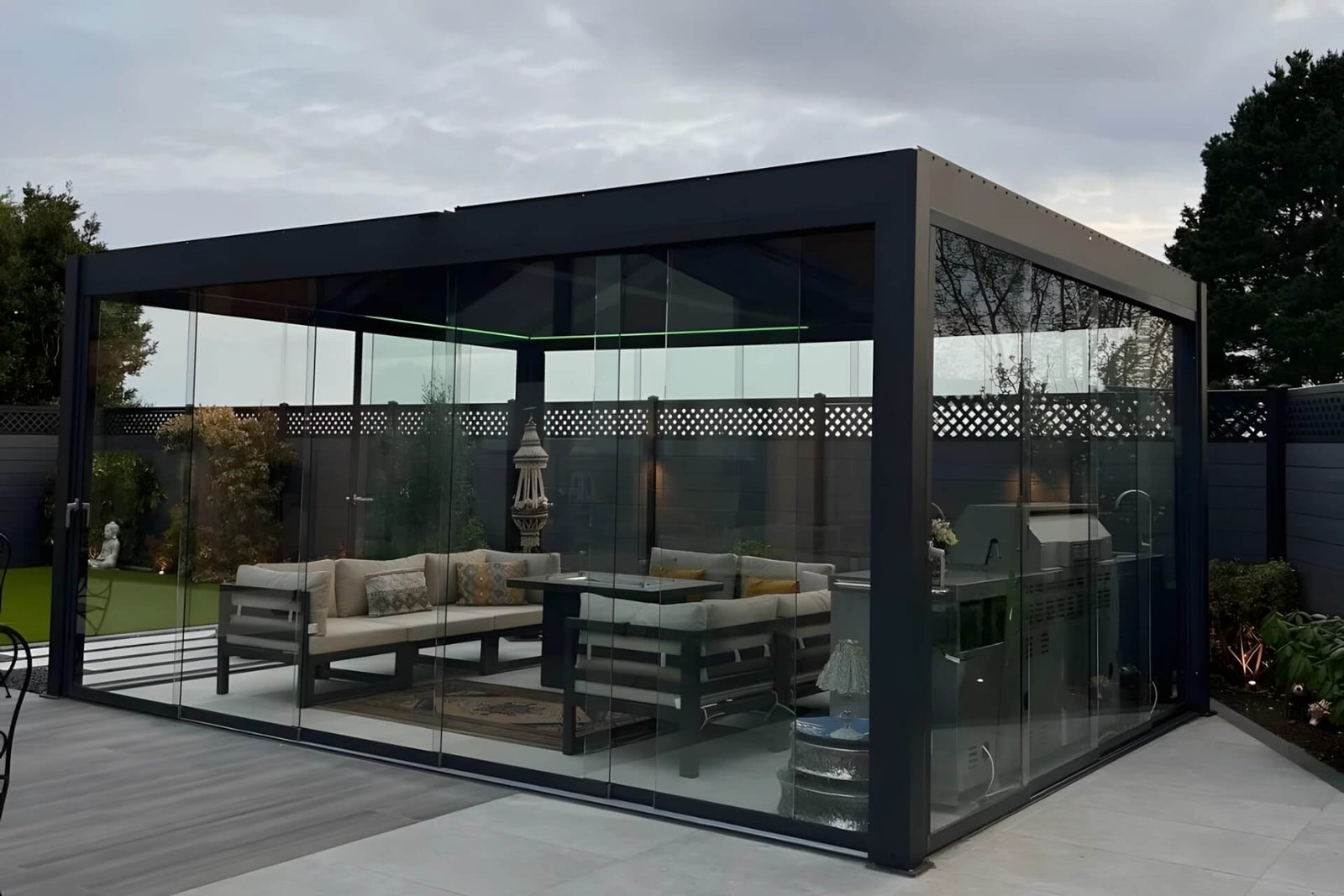
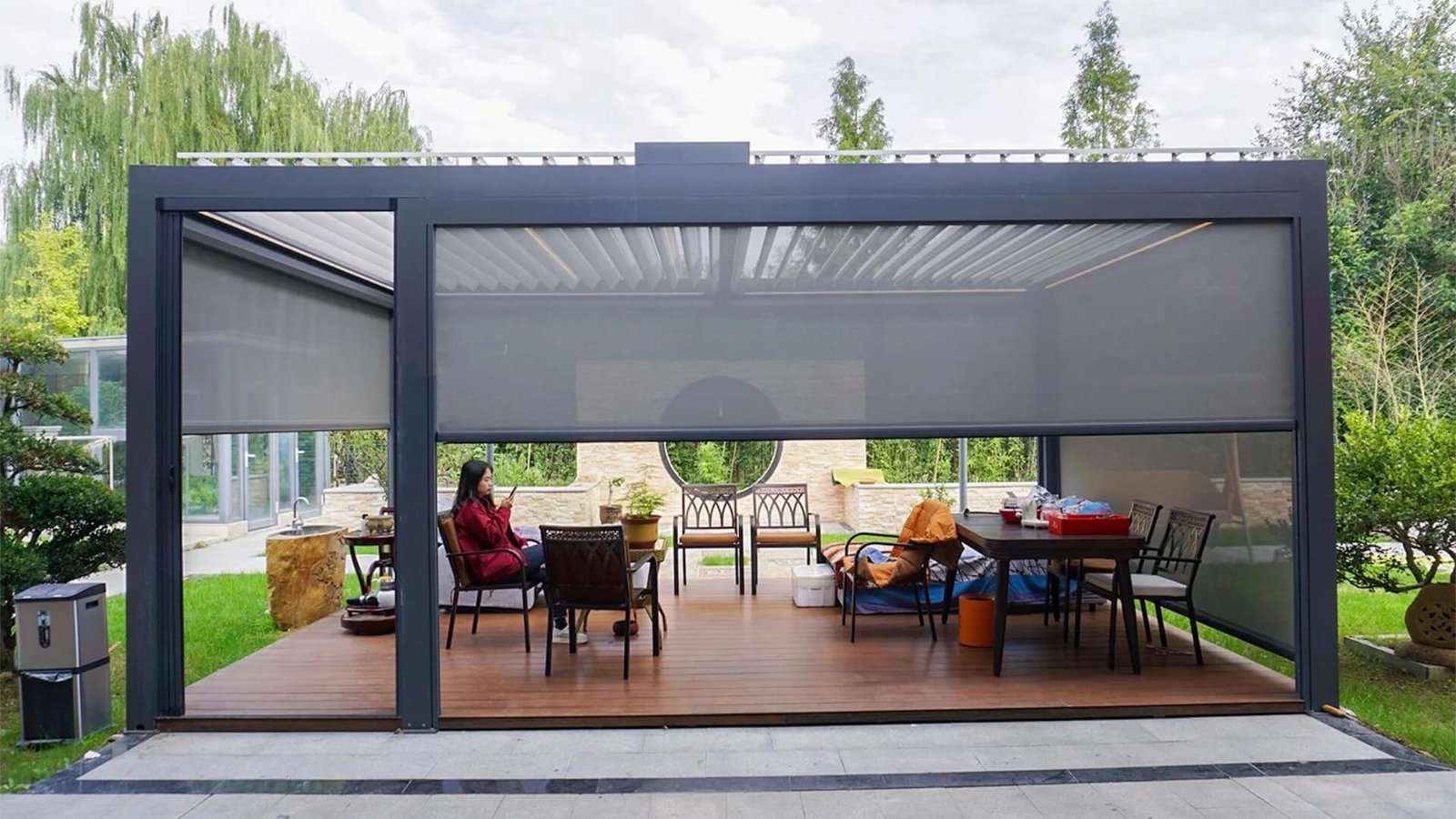
On a beachfront dining terrace, the wind isn’t only a structural threat — it’s a comfort problem. Drop-down zip screens or glass panels block gusts while preserving the view, extending the usable season. This is exactly the approach we took on a coastal hotel project, integrating motorized louvers with retractable side screens so staff could shield diners from afternoon glare and evening breeze on demand.
Internal link opportunity: For step-by-step guidance on footings, anchoring, and grading, read our site preparation and installation planning guide.
4. Waterproofing and Drainage: The Detail That Keeps Coastal Guests Dry
On the coast, rain arrives suddenly and often sideways. A truly coastal-grade pergola must manage water, not just block sun.
Closed-louver waterproofing. The best bioclimatic pergolas achieve full waterproofing when louvers are closed, thanks to interlocking louver profiles and integrated gaskets. This matters doubly on a beachfront, where an afternoon squall can arrive with almost no warning.
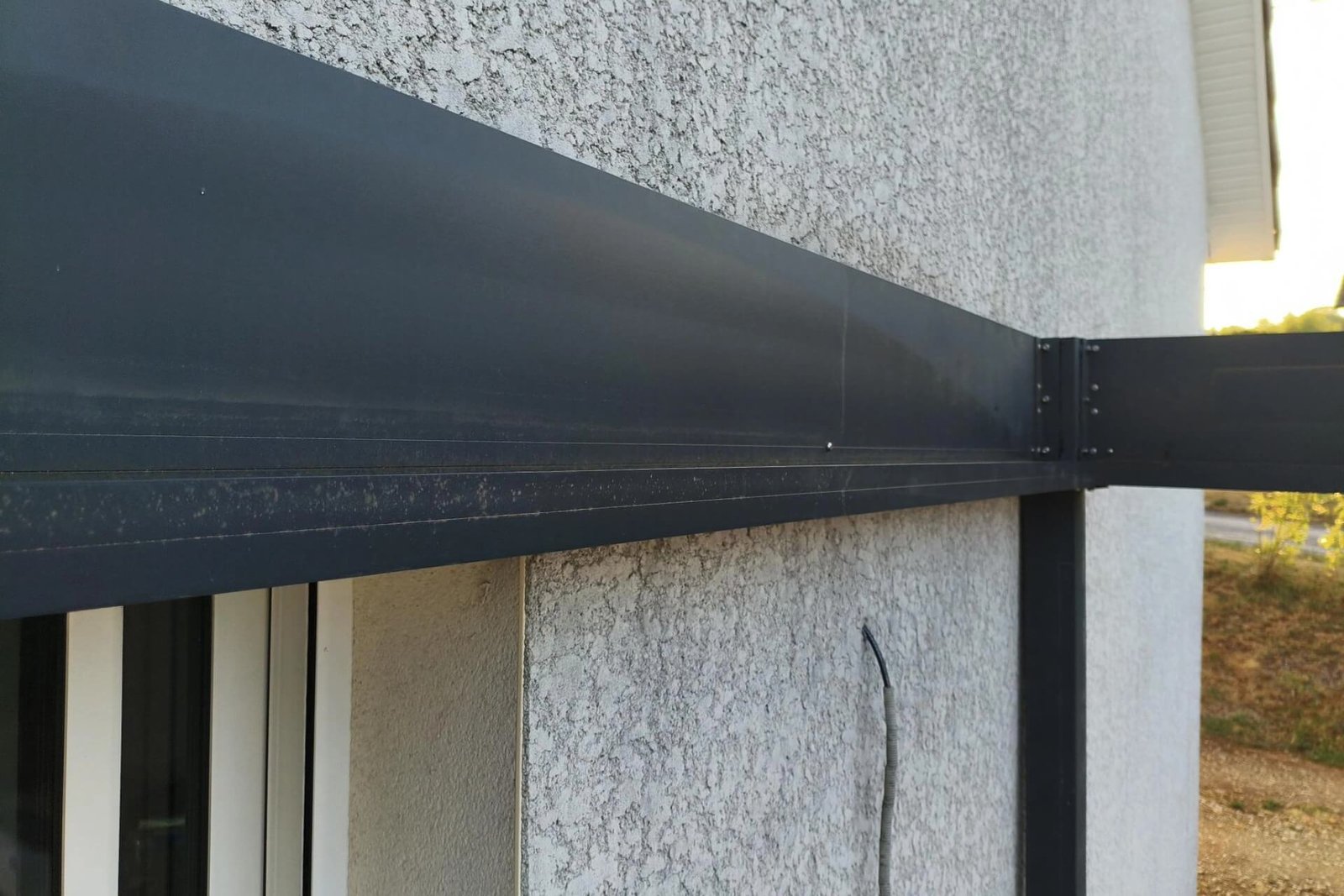
Integrated drainage. Water that runs off the roof must be channeled away, not allowed to pool or drip onto guests. Integrated gutter systems concealed within the beam profile route water to downpipes without visible pipes cluttering the architecture.
Coastal sealing. Because salt accelerates gasket and seal degradation, coastal projects should specify UV-stable, salt-resistant seals. A cheap gasket that hardens and cracks in one season will quietly reintroduce leaks into a “waterproof” roof.
Internal link opportunity: See how motorized louvers, waterproof sealing, and smart controls come together in our motorized bioclimatic pergola product line.
5. Case Study: A Coastal Pergola That Became the Centerpiece of a Moroccan Boutique Hotel
Theory is useful; a completed installation is proof. Here’s how we solved a real coastal hospitality challenge.
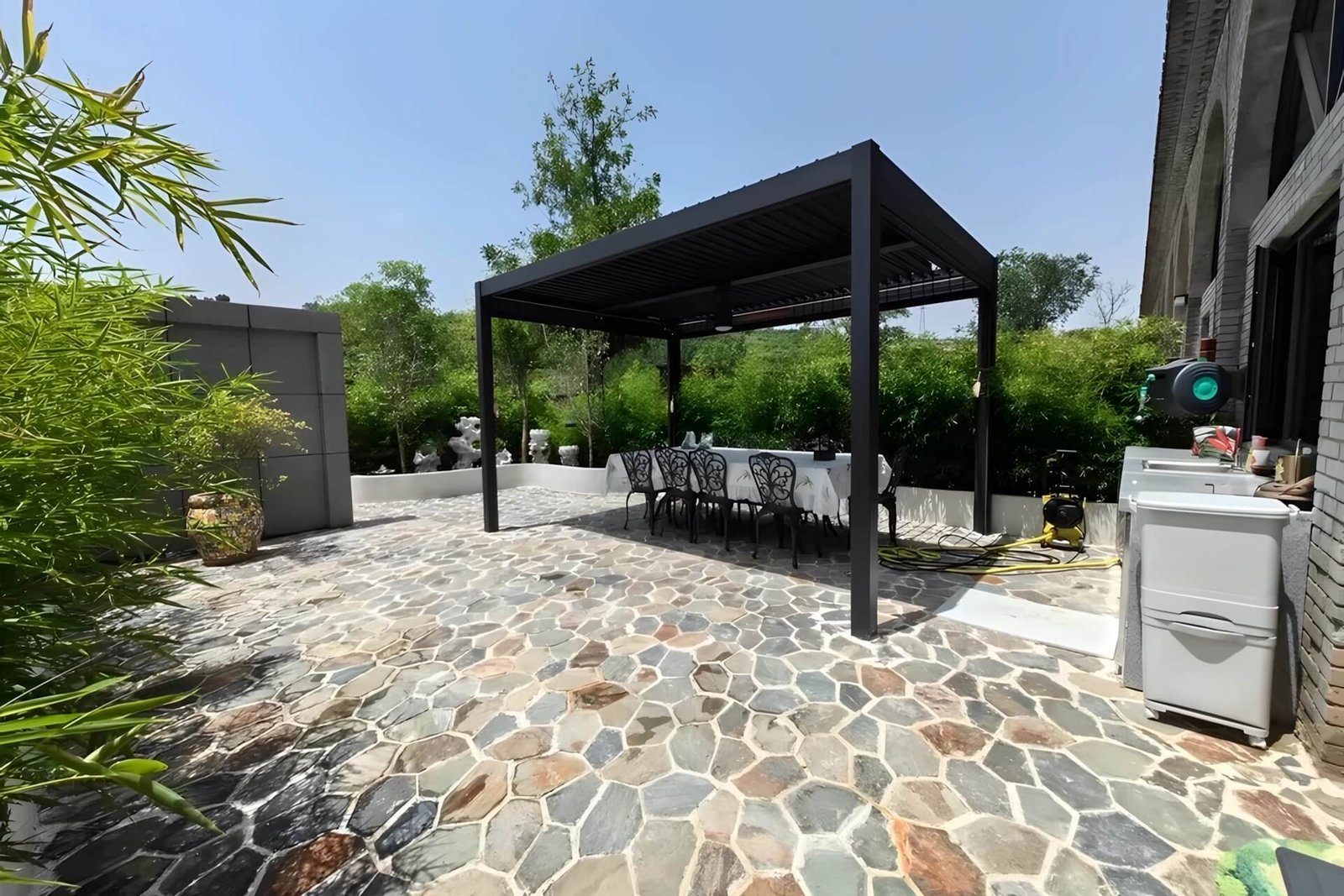
The challenge. A boutique hotel in Morocco wanted to transform its stone courtyard — framed by traditional arched architecture — into an all-weather outdoor dining and relaxation area. The owners needed a structure that would complement the heritage design while standing up to the intense North African sun and coastal breeze.
The solution. After evaluating multiple suppliers, the hotel chose a fully customized motorized bioclimatic pergola from our factory. The final specification included:
- A motorized louvered roof for precise sun and ventilation control, letting the hotel open the space to morning light and seal it against midday heat.
- Integrated LED ambient lighting, extending the dining area’s usability into the evening and creating a romantic atmosphere for guests.
- Drop-down zip screens on the sides, allowing staff to block harsh winds and late-afternoon glare on demand.
The result. To ensure the structure arrived pristine after its sea voyage, we shipped it in reinforced, heavy-duty wooden crate packaging. Today, the pergola stands as the focal point of the hotel’s courtyard, earning consistent praise from both the owner and guests — a commercial-grade structure that looks as considered as the heritage architecture around it.
This is what “coastal-grade” means in practice: not a generic product shipped to a beach, but an engineered structure specified around the site’s climate, the property’s architecture, and the operator’s commercial goals.
Internal link opportunity: Read the full story and see the result in our Morocco boutique hotel case study, or browse more customer stories from coastal and luxury projects worldwide.
6. A B2B Buyer’s Checklist: 8 Things to Verify Before You Source a Coastal Pergola
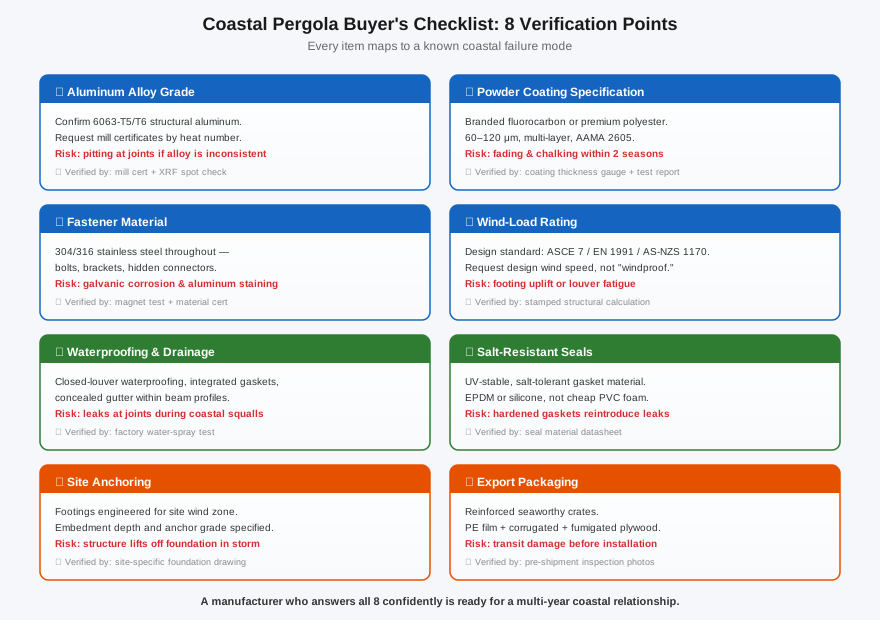
Use this checklist when evaluating any supplier for a beachfront or coastal project. Every item maps to a known coastal failure mode.
- Aluminum alloy — Confirm 6063-T5/T6 structural aluminum, not mixed or clad material.
- Coating specification — Ask for the powder-coating brand and layer specification (fluorocarbon or premium polyester).
- Fastener material — Verify 304/316 stainless steel hardware throughout, including hidden connectors.
- Wind-load rating — Request the design standard (ASCE 7 / EN 1991 / AS/NZS 1170) and design wind speed.
- Waterproofing — Confirm closed-louver waterproofing with integrated gaskets and concealed drainage.
- Salt-resistant seals — Ensure gaskets and seals are UV-stable and salt-tolerant.
- Site anchoring — Ask how footings and anchoring are engineered for your specific wind zone.
- Export packaging — Verify reinforced, seaworthy packaging for long-distance ocean freight.
A manufacturer that answers all eight confidently is one you can build a multi-year coastal relationship with.
Internal link opportunity: Before you shortlist a factory, learn how to run a proper audit with our B2B factory audit and quality control guide.
7. Conclusion: Source for the Coast, Not for the Catalog
Coastal and beachfront properties represent some of the highest-value outdoor spaces in hospitality — and some of the harshest environments for shading structures. The difference between a pergola that anchors a five-star guest experience and one that becomes a liability comes down to a handful of engineering decisions made long before installation: the alloy, the coating, the fasteners, the wind-load rating, and the waterproofing.
At Oudeoutdoor, we manufacture coastal-grade aluminum bioclimatic pergolas in our 15,000㎡ automated facility, with full OEM/ODM support for hotel groups, resort developers, and distributors worldwide. Whether you’re specifying for a single boutique courtyard or a multi-site beachfront portfolio, our engineering team works from your site’s wind zone and climate — not from a standard catalog.
Ready to specify a pergola that’s built for your coast? Send us your project dimensions and location, and our team will return a tailored engineering proposal and quote within 24 hours.