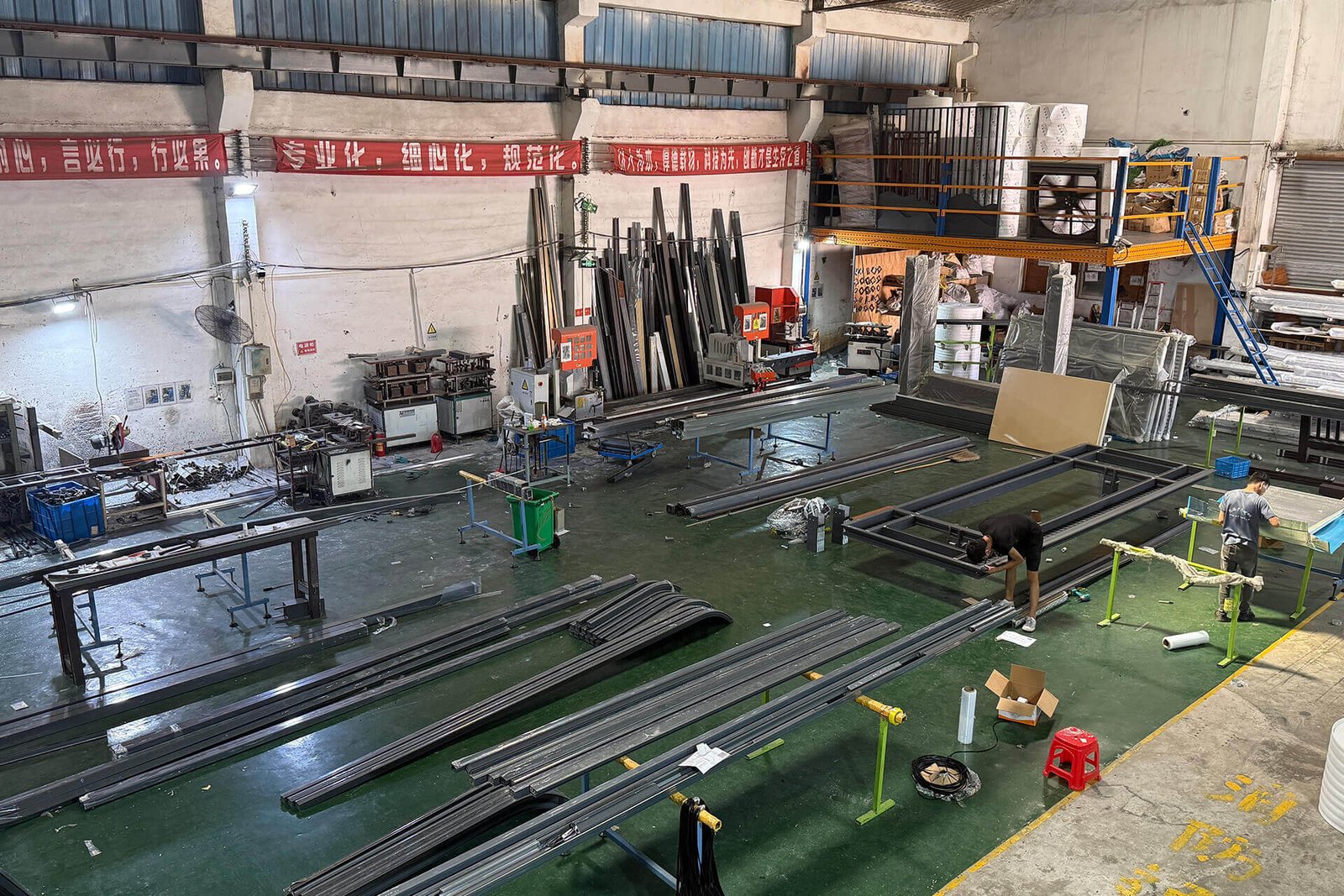
Every B2B buyer in the outdoor structure market has a story about a supplier who looked perfect on the website—beautiful product photos, impressive factory shots, responsive sales team—and then delivered something that didn’t match. Maybe the wall thickness was 2.0mm instead of the specified 2.8mm. Maybe the powder coating started flaking after one season. Maybe half the fasteners in the container weren’t stainless steel.
The gap between what a factory promises and what it actually produces is not always a matter of bad faith. More often, it comes from a lack of systematic quality control and from buyers who didn’t know what to ask for, or how to verify the answers.
This guide is about closing that gap. It walks through the evaluation and qualification process for aluminum outdoor structure manufacturers—from desktop research to factory audit to inline QC and pre-shipment inspection. Whether you’re sourcing motorized pergolas, heavy-duty carports, or polycarbonate canopies, the same principles apply.
1. Start with Certification Verification, Not Sales Claims
The first filter for any new supplier is documentation. But not all documentation is equally useful. A supplier that says “we are ISO 9001 certified” is making a claim. A supplier that can send you a certificate number you can independently verify on the issuing body’s website is providing evidence.
For aluminum outdoor structures, the certificates that actually matter fall into three categories:
Material and process standards. Aluminum profiles should conform to ASTM B221 or EN 755. These standards define alloy composition, temper, mechanical properties, and dimensional tolerances. A factory that cannot tell you which standard its profiles meet—or that responds with “our aluminum is high quality”—is operating without a defined material baseline. Ask for mill certificates for the specific heat numbers in your order, not a generic “certificate of conformity.”
Surface treatment certification. For powder coating, the relevant benchmark is AAMA 2604 or AAMA 2605, which specify salt spray resistance (typically ≥1,000 hours for AAMA 2604, 4,000+ for AAMA 2605), color retention, and gloss retention. Request test reports from a recognized third-party laboratory. If the factory does its own salt spray testing, ask about the testing equipment, calibration records, and whether the test was conducted on production samples or laboratory-prepared coupons.
Quality management certification. ISO 9001 is the baseline. It does not guarantee product quality, but it does indicate that the factory has a documented quality management system with defined processes, corrective action procedures, and internal audit protocols. Factories without ISO 9001 are not automatically disqualified, but they require closer scrutiny during the audit phase.
The verification step is where you separate factories with real systems from those with marketing materials. If a supplier cannot produce verifiable certificates within 48 hours, that itself is a signal.
2. The Desktop Evaluation: What to Check Before You Visit
Before booking a flight to Foshan or scheduling a video call, a significant amount of evaluation can be done remotely. The goal is to narrow your shortlist from a dozen candidates to two or three that merit deeper investigation.
Check the business model. Is the supplier a manufacturer or a trading company? This matters because trading companies may not control production, which affects your ability to customize, resolve quality issues, and get technical support. The terms “manufacturer” and “supplier” are often used interchangeably, but they describe different roles. Ask directly: which legal entity signs the contract, which facility produces the structure, and who owns the technical drawings? A professional factory should be able to explain these relationships without ambiguity.
Review the product engineering depth. A factory that genuinely engineers its products will have technical drawings, profile sections, and component lists that it can share under NDA. A trading company that resells other factories’ products typically cannot produce these documents. Ask for a section drawing of a typical post and beam connection. If the response is a catalog photo, that tells you something.
Look for evidence of production capability. Request recent production photos—not catalog shots. Ask how many containers the factory ships per month. A factory that ships 10 containers monthly is in a different operational category from one that ships 100. Neither is inherently better for your project—a smaller factory may offer more customization flexibility, a larger one more consistent tolerances—but you should know which you’re dealing with. Our article on the 15,000m² facility describes what an automated production floor looks like in practice.
Check operational reliability indicators. If the supplier has an online B2B profile, look at metrics like on-time delivery rate and reorder rate. An on-time delivery rate below 90% suggests logistics or production planning weaknesses. A reorder rate above 30% indicates that existing clients are coming back—a stronger signal than any sales pitch.
3. The Factory Audit: What to Look For on the Floor
A factory audit is not a tour. It is a structured inspection with specific checkpoints. If you cannot visit in person, a live video walkthrough with a defined checklist can substitute for most purposes. The key is to know what to look at.
3.1 Extrusion and Incoming Material Control
Quality problems in aluminum structures almost always originate upstream. If the profiles themselves are out of tolerance, no amount of downstream inspection fixes them.
During the audit, ask to see:
- Die condition and maintenance records. A worn die produces profiles with inconsistent wall thickness. One wall might measure 2.8mm while the opposite wall is 3.4mm—a difference that causes uneven flexing under wind load.
- Incoming material inspection records. Does the factory verify wall thickness, straightness, and surface quality when profiles arrive? A 4-meter beam should not bow more than 2mm.
- Alloy verification. For critical structural members, portable X-ray fluorescence (XRF) testing can confirm alloy composition on the spot. If the factory has no way to verify alloy grade, material substitution risk is higher.
3.2 In-Process Quality Control
The most important question in a factory audit is not “what do you check?” but “how do you record what you check?” A factory that inspects but doesn’t document is relying on individual diligence, which does not scale across production runs.
Look for:
- Defined inspection checkpoints. A professional factory should have checks at defined stages: incoming material, post-extrusion, pre-coating, post-coating, pre-assembly, and pre-shipment. Ask to see the inspection sheets for a recent order.
- Sampling plans and acceptance criteria. “We check every piece” is often not true, and even if it is, it doesn’t define what “check” means. Ask about sampling levels (AQL or equivalent), measurement methods, and what happens when a measurement falls outside tolerance.
- Non-conformance records. Every factory has defects. The question is whether they are recorded and resolved, or quietly pushed downstream. Ask to see the non-conformance log from the past three months.
3.3 Surface Finishing
Powder coating is where appearance and corrosion resistance are determined. The audit should cover:
- Pre-treatment process. Coating adhesion depends on proper pre-treatment: degreasing, etching, and chromate or non-chromate conversion coating. Ask to see the pre-treatment line and the chemical control records.
- Coating thickness measurement. A calibrated coating thickness gauge should be used on production parts. Typical architectural powder coating is 60–120 microns. Readings below 40 microns suggest process control issues.
- Cure verification. Powder coating must be cured at the correct temperature and time. Ask how the factory verifies cure—solvent rub testing, MEK double rubs, or differential scanning calorimetry (DSC).
3.4 Assembly Fit and Functional Testing
This is where problems that were invisible on paper become visible. A factory that performs pre-assembly testing catches issues before they reach the customer.
During the audit, ask to observe:
- A trial assembly of a representative unit. Beam-to-post connections should mate without forcing. Louvers should rotate smoothly through their full range. Drainage channels should align.
- Motor and control testing. For motorized systems, cycle the louvers open and closed. Listen for asynchronous sounds that indicate misalignment. Check that the remote responds reliably and that limit switches stop the louvers at the correct positions.
- Water ingress testing. For systems with integrated drainage, a simple water test on the closed louver roof can reveal leaks at joints or inadequate gutter capacity. This is far cheaper to catch at the factory than after installation.
4. Sample Testing and Third-Party Inspection
A factory audit tells you how the factory operates on a good day. Sample testing and third-party inspection tell you what the product actually does.
Pre-production sample. For any order of significance, require a pre-production sample. This is not the same as a catalog sample—it should be built from the same profiles, with the same coating, by the same production team that will make your order. Test it for fit, finish, and function. We covered the sampling process in our sourcing guide.
Third-party inspection. SGS, Bureau Veritas, TÜV, and Intertek all offer pre-shipment inspection services in China. A typical inspection covers quantity verification, dimensional checks, coating thickness, assembly fit, and packaging condition. The cost is modest relative to the value of catching a defect before the container ships.
Performance testing. For commercial projects where code compliance is required, request test reports for structural loading per the applicable standard—ASCE 7, EN 1991, or AS/NZS 1170. Some factories have in-house testing capability; others rely on external laboratories. Either is acceptable as long as the test is conducted on a representative assembly and the report identifies the specific standard and load cases. We’ve written about the engineering basis for these tests in our guide to wind and snow load engineering.
5. Red Flags and Dealbreakers
Some issues should stop a supplier evaluation immediately. Others are warning signs that require further investigation.
Immediate red flags:
- Refusal to provide a mill certificate or alloy verification for structural profiles.
- Inability to state which design standard the structure is engineered to.
- No defined inspection records, or refusal to share them under NDA.
- Pressure to skip sample approval “because we’ve made this model many times.”
- No third-party inspection allowed—only the factory’s own QC.
Warning signs requiring deeper investigation:
- Sales team cannot answer technical questions and must “check with the engineer” on every point.
- Factory photos look like stock images or are inconsistent with the claimed facility size.
- The factory can customize color but not dimensions, or vice versa.
- Warranty terms are verbal, not written, or exclude structural components.
6. Building a Long-Term Supplier Relationship
Supplier qualification is not a one-time event. The best buyer-supplier relationships involve ongoing quality monitoring and periodic re-evaluation.
Post-order review. After each container ships, review the inspection reports, any defect claims, and the resolution timeline. A supplier that resolves issues quickly and transparently is more valuable than one that has never had a problem—because every factory eventually has one.
Annual re-audit. For ongoing supply relationships, an annual factory audit—even a remote one—keeps quality standards from drifting. Key metrics to track: on-time delivery rate, defect rate per container, response time to technical questions, and accuracy of production against approved drawings.
Spare parts and technical support. A supplier that can provide spare motors, louver pivots, drainage seals, and touch-up paint for years after the original order is a partner, not a vendor. Ask about spare parts availability before you need them.
At Oude Outdoor, we welcome factory audits—in person or by video—and we provide inspection records, mill certificates, and structural calculations as standard practice. Our Foshan facility is built around CNC precision, and our engineering team works in ASCE 7 and EN 1991 daily. We don’t ask buyers to trust us. We ask them to verify.
7. Conclusion: Qualification Is a Process, Not a Conversation
The difference between a good supplier and a bad one rarely shows up in a quotation. It shows up in whether the alloy is what it claims to be, whether the coating thickness is measured or assumed, whether the inspection records exist, and whether the factory is willing to let you look behind the curtain.
If you’re sourcing aluminum outdoor structures for a commercial project, treat supplier qualification with the same rigor you’d apply to any other capital procurement. Verify certifications. Audit the factory. Test the sample. Inspect before shipment. Track performance after delivery.
And if you’re evaluating Oude Outdoor as a potential partner, start with the questions in this guide. We’re happy to answer them.
Contact Oudeoutdoor for a factory audit appointment, sample request, or technical documentation package. Our engineering team responds within 24 hours.